REP. IVEY LEADS BIPARTISAN CODEL TO WITNESS SUCCESSFUL LAUNCH OF NANCY GRACE ROMAN SPACE TELESCOPE
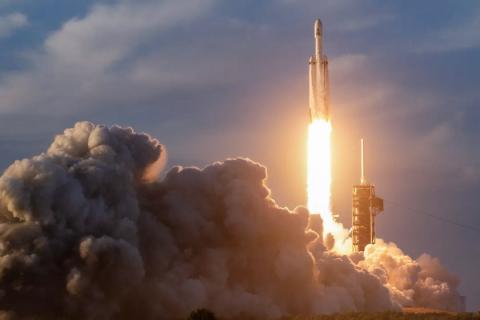
WASHINGTON — Congressman Glenn Ivey (MD-04) led a bipartisan delegation of Members of Congress to Cape Canaveral, Florida, from Saturday, August 29 through Monday, August 31, in partnership with the U.S. Space Force and NASA, to witness the successful launch of NASA's Nancy Grace Roman Space Telescope.
The Roman Space Telescope lifted off aboard a SpaceX Falcon Heavy rocket at 7:26 a.m. EDT on Sunday, August 30, from Launch Complex 39A at NASA's Kennedy Space Center, and reached orbit roughly 10 minutes later. The delegation observed the launch in person and met with Space Force and NASA leadership to discuss the future of the U.S. space and space science enterprise.
“The successful launch of the Nancy Grace Roman Space Telescope is a tremendous achievement for NASA and a proud moment for Maryland. I congratulate the exceptional NASA Goddard workforce and every partner whose expertise and dedication made this mission possible—especially nine months ahead of schedule and under budget. This observatory will reveal to us distant worlds, helping us understand dark matter and dark energy, and inspire the imagination of the next generation. Goddard’s critical scientific missions continue to reaffirm America’s global leadership in space science and will now advance discovery for years to come,” said Congressman Ivey, representative of Maryland’s Fourth District.
The delegation included Representatives George Whitesides (D-CA), Suhas Subramanyam (D-VA), and Mike Haridopolos (R-FL). Science communicator Bill Nye the Science Guy also joined the delegation for part of the trip.
ABOUT THE MISSION
Named for NASA's first chief astronomer, known as the “mother of Hubble,” the Nancy Grace Roman Space Telescope is NASA's next flagship observatory and its most significant astrophysics mission since the James Webb Space Telescope. Roman carries a primary mirror with a field of view at least 100 times larger than Hubble's, enabling it to survey wide swaths of the sky to study dark energy and dark matter, search for exoplanets, and advance infrared astrophysics. The observatory launched roughly nine months ahead of its required launch readiness date and is now on a three-month journey to join Webb at the second Sun-Earth Lagrange point (L2), where it will operate collaboratively with Hubble and Webb to give humanity an unprecedented view of the universe, paving the way for future observatories in the search for signs of life beyond our solar system.
PARTNERS
Roman is a worldwide collaborative effort, featuring a network of 85 national partners across 17 states and 13 international partners across 9 countries. More information about the global network of partners contributing to this mission can be found at: https://science.nasa.gov/mission/roman-space-telescope/partners/
ABOUT CONGRESSMAN IVEY
Congressman Glenn Ivey represents Maryland's 4th Congressional District, home to NASA's Goddard Space Flight Center, which manages the Roman Space Telescope mission. Ivey has been an active advocate in Congress for Goddard's workforce and mission portfolio.